Mass Cytometry

Mass cytometry is a high-throughput multiparameter bioanalytical technique for studying biomarker expression on individual cells. Antibodies or other reagents are used to label the cells with isotopes of heavy atoms (mass tags) that can then be detected by atomic mass spectrometry with single mass resolution. In suspension mass cytometry (SMC), cells and mass tags are vaporized, atomized and ionized to create an ion cloud that enters the time-of-flight detection. They are then separated by their mass-to-charge ratio. In imaging mass cytometry (IMCTM), a laser is used to ablate small (~1 µm2) regions of a tissue section so that the plume is carried into the plasma torch of the MC instrument. By rastering the sample, an image of biomarker distribution in the tissue sample can be created. We aim to design versatile mass tags that can enable simultaneous detection of multiple biomarkers that will give sensitive signals from MC.
Metal-Chelating Polymers (MCPs)

Metal-chelating polymers are polymers with repeating chelator pendant groups that can carry metal isotopes. The polymer also contains functional group to conjugate to antibodies. MCPs have previously shown to effectively differentiate biomarkers on mass cytometry.
Mesoporous Silica Nanoparticles (MSNs)
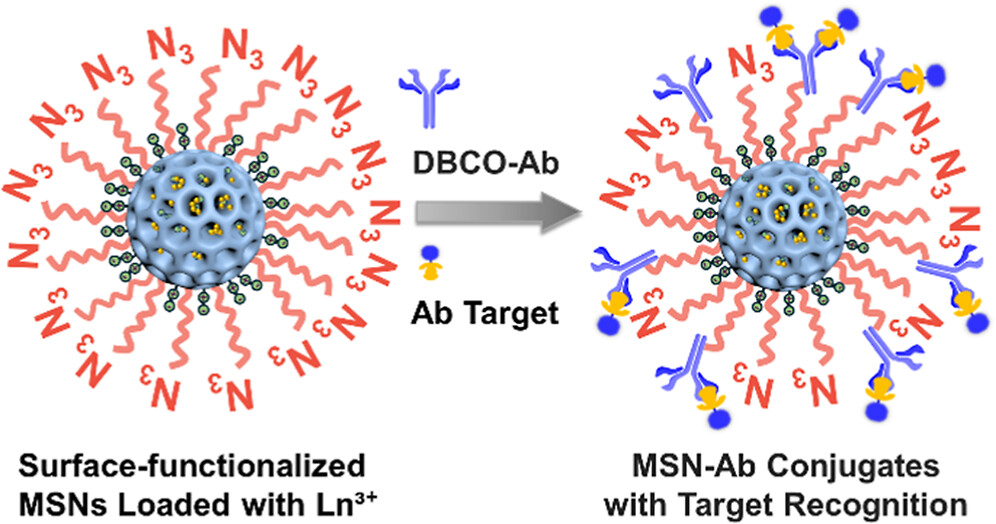
Mesoporous silica nanoparticles (MSNs), composed of silica, are a promising material for mass tags. Their large surface area allows an efficient metal loading for higher signal intensity, while the abundance of silanol groups on the surface of MSNs allows various chemical modifications (e.g., polymer grafting) and Ab conjugation.
Polymer Chemistry in Latex Films

For more than 20 years, we have worked with scientists in the coatings industry to help them prepare waterborne coatings that are environmentally compliant with high performance. We developed methods based on fluorescence resonance energy transfer (FRET) to study polymer diffusion across interfaces in latex films. In this way, we were able to develop an understanding of how various additives or chemical properties affect film formation. Since 2014, we have been working closely with scientists at BASF to study the mechanistic aspects of novel coating formulations developed in company laboratories.
Rod-like Nanoparticles and Cellulose Nanocrystals (CNCs)

Elongated colloidal nanoparticles have significant potential for drug delivery and imaging in cancer therapy. Cellulose nanocrystals (CNCs) are biocompatible, rodlike colloids that are broadly surface-functionalizable, making them interesting as modular drug carriers. We are investigating the surface modification of the CNCs with various polymers and their versatile applications.